Хто одружився на Catherine Pavlovna of Russia?
Ольденбургський Георгій Петрович одружений Catherine Pavlovna of Russia . Catherine Pavlovna of Russia був 20 рік у день весілля (20 роки 11 місяців 21 дні). Ольденбургський Георгій Петрович був 25 рік у день весілля (25 роки 0 місяців 3 дні). Різниця у віці склала 4 роки 0 місяців 12 дні.
Шлюб тривав 3 роки 7 місяців 27 дні (1337 днів). Шлюб розірвався року.
Вільгельм I одружений Catherine Pavlovna of Russia . Катерина Павлівна Романова був 27 рік у день весілля (27 роки 8 місяців 3 дні). Вільгельм I був 34 рік у день весілля (34 роки 3 місяців 28 дні). Різниця у віці склала 6 роки 7 місяців 24 дні.
Шлюб тривав 2 роки 11 місяців 16 дні (1081 днів). Шлюб розірвався року.
Catherine Pavlovna of Russia: Хронологія статусу шлюбу
1 Pixel = 1 Month

Catherine Pavlovna of Russia

Catherine Pavlovna of Russia (Russian: Екатерина Павловна; 21 May [O.S. 10 May] 1788 – 9 January 1819) was Queen of Württemberg from 30 October 1816 until her death in 1819 as the wife of William I of Württemberg.
Catherine was born as the fourth daughter of Emperor Paul I of Russia and Duchess Sophie Dorothea of Württemberg. She firstly married Duke George of Oldenburg in 1809 until his death in 1812, remarrying to William I of Württemberg in 1816.
Детальніше...
Ольденбургський Георгій Петрович

Duke Peter Frederick George of Oldenburg (German: Herzog Peter Friedrich Georg von Oldenburg; 9 May 1784 – 27 December 1812) was a younger son of Peter I, Grand Duke of Oldenburg and his wife Duchess Frederica of Württemberg. He was a son-in-law of Paul I of Russia through marriage to his daughter Grand Duchess Catherine Pavlovna of Russia. He was referred to as a prince in Russia, Prince Georgy Petrovich Oldenburgsky.
Детальніше...Місце весілля
Catherine Pavlovna of Russia
Вільгельм I
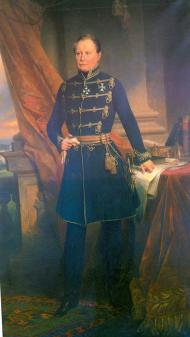
William I (German: Friedrich Wilhelm Karl; 27 September 1781 – 25 June 1864) was King of Württemberg from 30 October 1816 until his death.
Upon William's accession, Württemberg was suffering crop failures and famine in the "Year Without a Summer", in 1816. After taking office, he initiated sweeping reforms, resulting in the approval of the Estates of Württemberg to a constitution on 25 September 1819. In his 47-year reign, the kingdom moved from one that was created from different denominational principalities and a heterogeneous agricultural country, into a constitutional state with a common identity and a well-organised management.
In addition to his successful domestic policy, he pursued throughout his reign an ambition focused on German and European foreign policy. Alongside the great powers of Prussia and Austria, he imagined a third major German power in the form of Bavaria, Saxony, Hanover and Württemberg. Although this plan never succeeded, it ensured a consistent, coherent and targeted policy during his reign.
William was the only German monarch who was forced to recognise the Frankfurt Constitution of 1848. After the failure of the March Revolution of 1848, he pursued reactionary policies that counteracted his liberal image from before the revolution. He died in 1864 at Rosenstein Castle in Bad Cannstatt and is buried in the Württemberg Mausoleum.
Детальніше...